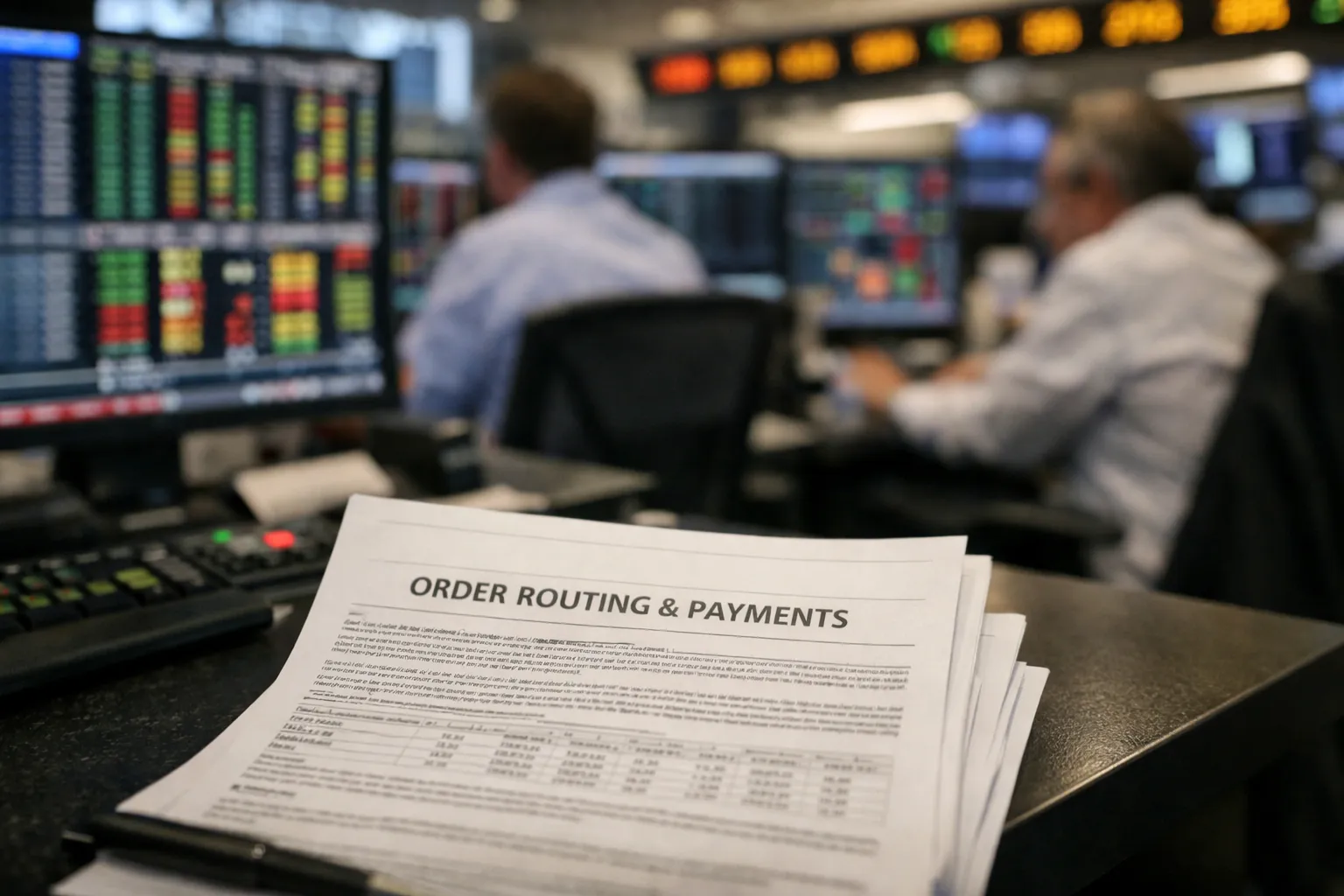
Debate over payment‑for‑order‑flow (PFOF) has returned to the center of U.S. market‑structure discussions. For stock‑market investors, the stakes are straightforward: any meaningful restriction on PFOF would force retail brokers to change how they price trading, and force market makers to rework profit pools and quoting behavior. That in turn could affect liquidity, execution quality and the economics of exchange‑traded products.
Why PFOF matters to everyday investors
Payment‑for‑order‑flow is the practice whereby retail brokers route customer orders to market‑making firms or other execution venues in exchange for a per‑trade payment or a share of trading profits. Brokers say PFOF funds commission‑free trading, subsidizes platform development and helps lower retail trading costs. Market makers say PFOF compensates them for providing continuous two‑sided quotes and absorbing inventory risk.
Critics counter that PFOF creates conflicts of interest, can obscure differences in execution quality across brokers, and concentrates price improvement opportunities with a handful of large market‑making firms. For investors, the practical question is whether the retail trades they place today would face higher explicit costs, wider effective spreads, or slower fills if PFOF were curtailed.
What a restriction could change
- Broker economics — Commission‑free trading proliferated in the 2010s largely because PFOF provided an alternate revenue stream. Restricting or banning PFOF would push brokers to seek other revenues: list of likely options includes charging explicit commissions, expanding interest and margin income, introducing subscription fees, or monetizing data and premium services.
- Market‑maker profits — Firms that earned PFOF payments would see a direct hit to revenues. That could prompt thinner posted quotes, wider spreads, or reduced displayed size—changes that would increase implicit trading costs for all market participants.
- Order routing and venue economics — Exchanges and internalizers that benefited indirectly from PFOF flows would need new incentives to attract retail orders. This could accelerate the move toward maker‑taker fee rebalancing, fee rebates redesign, or alternative matching protocols.
Who stands to gain or lose
- Potential losers
- Pure retail brokers that rely heavily on PFOF revenue and offer zero‑commission trading as a core differentiator. These firms would need to alter pricing or cut other services.
- Large market‑making firms with a significant share of retail flow, if they cannot replace lost payments with trading profit alone.
- Retail investors who trade in small sizes where explicit commissions could outweigh current implicit costs — although the net effect depends on how execution quality changes.
- Potential winners
- Brokers with diversified revenue models — strong margin lending, subscriptions, or asset‑management fees — that can absorb higher order‑execution expenses without abrupt price changes.
- Transparent execution venues that can credibly demonstrate superior price improvement and fill rates; they could capture flow if retail brokers prioritize execution quality over payments.
- Institutional traders and long‑term investors, who may benefit from more uniform and transparent execution across retail channels.
Short‑term market signals investors should watch
- Broker disclosures — Quarterly filings and investor presentations that break out PFOF revenue, routing percentages and changes in execution quality metrics. Sudden declines in PFOF line items or increases in other fee categories are telling.
- Order‑routing shifts — Publicly disclosed routing statistics (where available) or third‑party analytics that show retail flow moving away from certain market makers or venues.
- Quoted liquidity and spreads — Monitor intraday NBBO spreads and displayed depth in high‑retail names. If market makers withdraw, microstructure changes can be visible quickly in small‑cap or high‑volatility stocks.
- Fee schedule changes — Exchange fee cards and broker commission announcements. Repricing moves from zero to even a few dollars per trade would materially alter retail trading behavior and volume.
Scenario planning for investors
Investors should consider three plausible scenarios and how to position for each.
- Minimal reform — Regulators tighten disclosure and best‑execution requirements but stop short of banning PFOF. Expect incremental improvements in transparency and only modest changes to broker economics. Action: monitor execution quality reports and prefer brokers that publish verifiable metrics.
- Partial restriction — PFOF is limited for certain order types or capped, and brokers must demonstrate neutral routing. Action: watch for fee experimentation; favor diversified brokerages and market‑makers with multiple revenue streams.
- Comprehensive ban — PFOF outlawed for retail equity trades. Action: prepare for a structural shift—potentially higher commissions, altered liquidity for small‑cap stocks, and short‑term volatility in retail‑heavy names. Reassess trading frequency and prefer execution via limit orders or through brokers with robust institutional routing capabilities.
Practical steps for retail investors
- Use limit orders for illiquid or small‑cap securities to control execution price.
- Track execution quality reports from your broker (price improvement, fill rates, routing) and compare periodically.
- Consider holding time horizon: active, small‑ticket traders are most exposed to changes in commissions and spreads.
The bottom line
Payment‑for‑order‑flow is more than an arcane market‑structure detail; it underpins much of the retail trading experience and broker economics. Any significant policy shift will ripple through brokers, market makers and exchanges and could change the cost and quality of trade execution for everyday investors. For stock‑market participants, the prudent course is to watch disclosure trends, liquidity metrics and fee announcements closely—and to adapt trading tactics to preserve execution quality as the debate plays out.