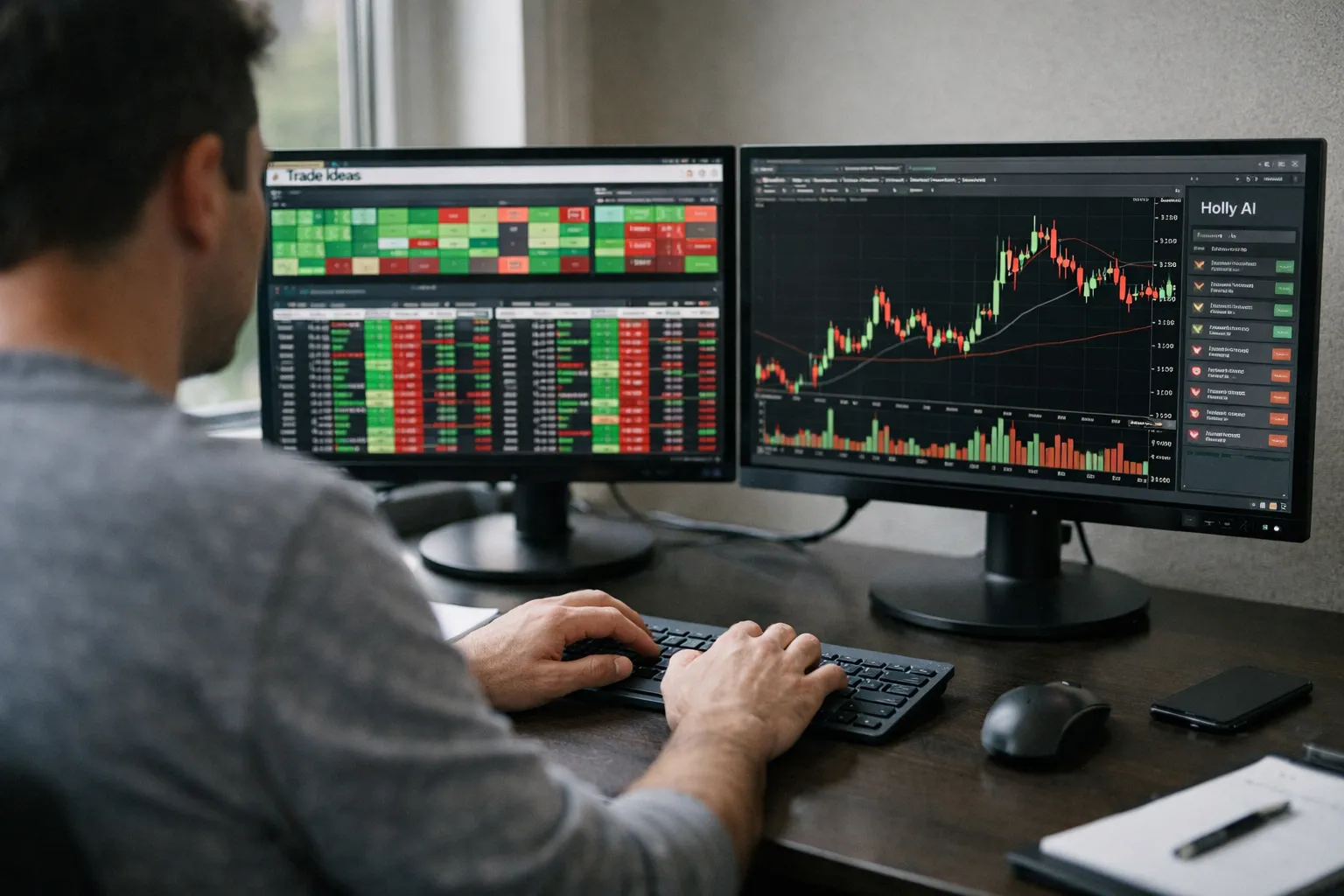
Trade Ideas has long marketed itself as the bridge between data-rich market scanning and automated idea generation. In 2026 the company's premium tier — centered on the "Holly" AI engine, real-time scanners, simulated trading and broker automation — remains one of the most feature-dense products aimed at active retail stock investors. This review evaluates the platform's core capabilities, where it excels, its real limitations, and which investors should consider paying up for Premium.
What Trade Ideas Premium offers in 2026
At its core, Trade Ideas blends three pillars: a very fast, customizable real-time scanner; an AI-driven idea engine (Holly) that generates trade setups and records historical performance of those ideas; and execution tools for paper trading and live trading through supported brokers. The Premium experience layers advanced backtesting, simulated trading (paper trading with portfolio tracking), and more aggressive automation features — including conditional alerts and automated order-routing.
Key features
- Real-time scanning: multi-criteria filters, prebuilt strategy templates, and low-latency streaming quotes for U.S. equities.
- Holly AI idea engine: runs ensemble strategies that combine pattern recognition, statistics and short-term optimization to recommend entries and exits with historical win-rate metrics.
- Backtesting and simulated trading: walk-forward testing of strategies, replay mode for intraday scenarios and extended paper-trading to evaluate signals without capital risk.
- Automation and broker integrations: API hooks and connectors that allow conditional automation for supported brokers (for users who want fully automated execution).
- Alerts and workspace customization: multi-monitor-ready layout, customizable alerts via desktop, mobile push and email.
Pros — where Trade Ideas shines
- Speed and depth of scanning: The platform processes thousands of quotes per second and lets you combine technical, volume and liquidity filters to find unusual movers in real time — a crucial advantage for intra-day and short-term momentum traders.
- Holly’s practical approach: Unlike pure black-box claims, Holly presents trade ideas with historical performance and the logic behind selections. That transparency helps traders evaluate expected outcomes rather than chase opaque “signals.”
- Integrated workflow for active traders: From idea to backtest to paper trade to automation — Premium enables a closed-loop workflow that reduces friction for traders who iteratively refine short-term strategies.
- Educational value for quant-curious users: The strategy templates and replay mode are useful for learning how different signals behave under varying market regimes.
Cons — realistic downsides and trade-offs
- Noise and signal volume: High-frequency scanning produces many signals. Without disciplined filtering and risk rules, users can be overwhelmed by false positives and low-quality setups.
- Cost and ROI considerations: Premium pricing is meaningful for retail budgets. The expense is justifiable only if you can convert a meaningful portion of the platform’s high-frequency ideas into disciplined trades.
- Steep learning curve: The interface and feature set are powerful but complex. Casual investors or long-term buy-and-hold accounts will likely find most features unnecessary.
- Execution risk with automation: Broker integration speeds up trades but increases operational risk (misconfigurations, slippage, and connectivity failures). Premium users need robust monitoring and conservative position-sizing rules.
How it performs in current 2026 market conditions
Markets in 2026 remain characterized by quick rotations between tech growth, AI-enabled winners, and episodic volatility. Trade Ideas' real-time scanning and Holly's short-term optimization are naturally aligned with environments where rapid information flow creates transient trading edges. In low-volatility, long-trend markets, however, the volume of short-horizon signals can produce distracting churn.
Concretely: if your approach is to catch two- to ten-day momentum moves, Trade Ideas can surface candidates faster than manual screening. If your horizon is three-plus months driven by fundamentals, the platform's strengths are less relevant and its alerts can be a distraction.
Practical examples and use cases
- Active momentum trader: Use a prebuilt momentum template, add a liquidity floor and earnings filter, and run Holly’s ideas in paper trading for two weeks. Tight risk rules (e.g., max 1–2% capital per trade) and a “reject list” for penny-stock churn turned out to be effective in testing.
- Quant hobbyist: Use replay mode to validate how a 20-day breakout performed across Q1–Q2 2026, then backtest variations before automating a scaled entry strategy.
- Long-term investor: Use the platform sparingly for event-based trades (merger arbitrage, post-earnings momentum) but rely on fundamental research elsewhere — Trade Ideas is supplementary, not a replacement.
Who should subscribe to Premium?
- Yes — for: day traders, multi-day momentum traders, quant-curious investors who want an end-to-end algo workflow, and users who will actively use backtesting and simulated trading.
- No — for: passive investors, long-term buy-and-hold retail traders who prioritize fundamentals, and those unwilling to commit time to master filters and risk controls.
Bottom line
Trade Ideas Premium with Holly AI remains one of the top choices for retail investors who want a high-performance, short-term trading toolkit in 2026. Its strengths — speed, integrated backtesting/paper-trading and transparent AI idea generation — align well with active, disciplined traders. The main barriers are cost, the platform’s signal noise, and the operational risk that comes with automation. For serious active traders, Premium can be a force-multiplier; for casual investors, a lighter, cheaper scanner or a fundamentals-first workflow will usually be a better fit.
Recommendation: trial the platform (use paper trading extensively), build conservative risk rules, and measure performance over a minimum sample of 50–100 trades before moving to live automated execution.