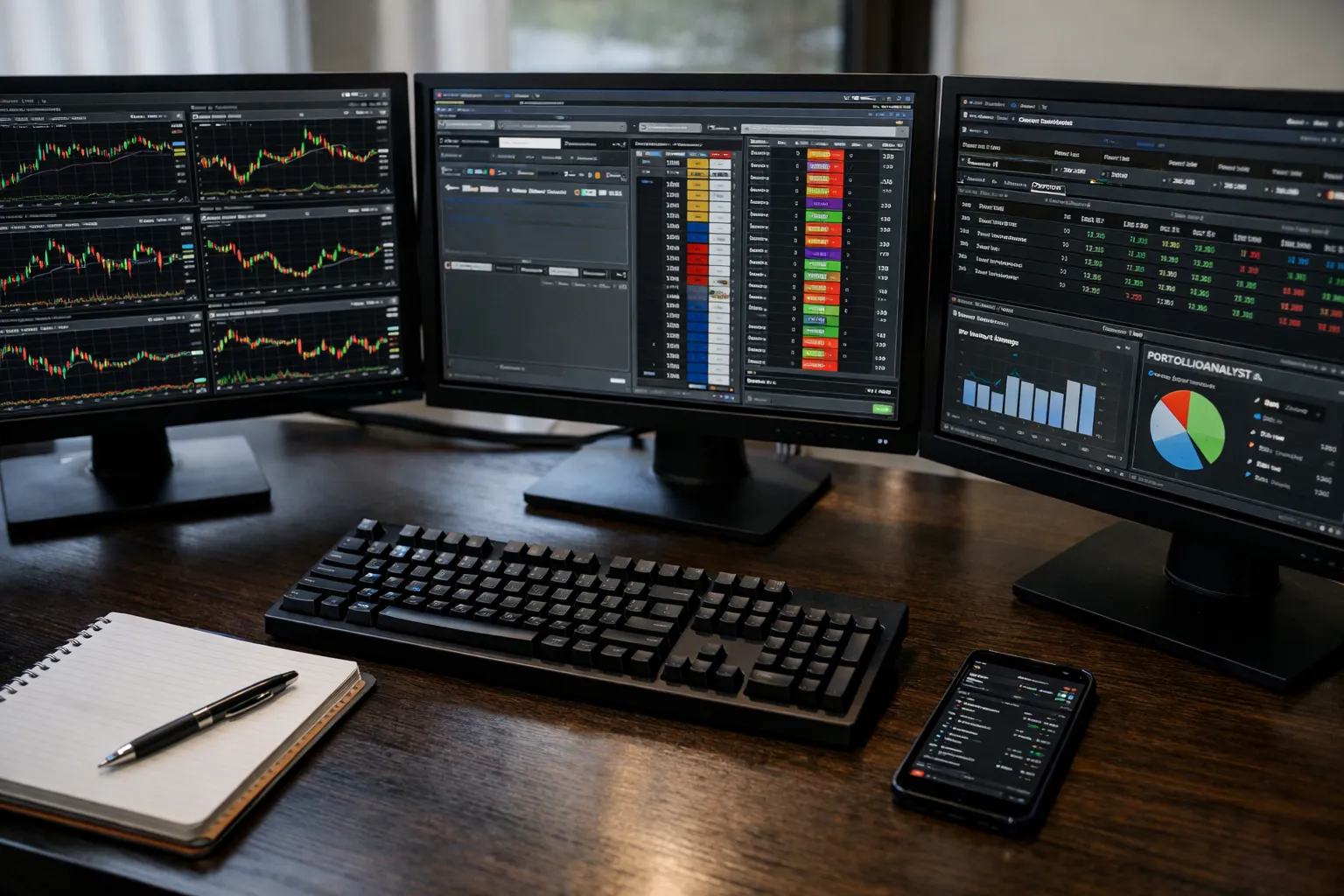
Interactive Brokers (IBKR) remains one of the most feature-rich brokerages available to retail stock investors in 2026. This review evaluates IBKR’s core platforms — Trader Workstation (TWS), Client Portal, and IBKR Mobile — alongside its pricing tiers (IBKR Lite vs IBKR Pro), API ecosystem, and the real-world tradeoffs for different investor types.
What this review covers
- Platform capabilities and ease of use
- Order types, execution and routing
- Pricing structure and indirect costs
- Data, research and APIs
- Who should use IBKR — and who should not
Platform overview: TWS, Client Portal and Mobile
IBKR offers a tiered platform strategy. Trader Workstation (TWS) is a desktop application aimed at active, professional-style traders. Client Portal is a streamlined web interface for portfolio management and trade entry. IBKR Mobile mirrors much of the Client Portal functionality on phones while offering key TWS features like advanced order entry.
TWS shines for power users: highly customizable layouts, advanced charting, bracket and algorithmlike orders, options analytics, and multi-leg order creation. It also exposes IBKR’s advanced routing tools and algos. The tradeoff is complexity — TWS has a steep learning curve and screens can feel cluttered until you customize them.
Client Portal is more approachable for buy-and-hold investors who still want low-cost execution and global market access. It consolidates account balances, positions, research links, and a simpler order ticket. The mobile app is competent: not as feature-dense as TWS, but strong for on-the-go order management and monitoring.
Notable platform features
- Paper trading: Full-featured demo accounts let you rehearse strategies and learn TWS without real capital.
- SmartRouting: Order routing that seeks the best available price across venues — valuable for active traders concerned with execution quality.
- PortfolioAnalyst: Built-in aggregation and performance reporting for cross-account analysis.
- IBKR API & IB Gateway: Programmatic access for custom strategies, automated execution, and third-party integration.
Pricing and account tiers: Lite vs Pro
IBKR continues to offer two primary retail tiers. IBKR Lite targets investors seeking $0 commission on many U.S.-listed stocks and ETFs, while IBKR Pro is built for active traders who prefer per-share or tiered pricing and advanced execution options. Beyond headline commissions, traders should watch for exchange, regulatory, and clearing fees — especially on high-volume or complex order flows.
IBKR is broadly competitive on costs. For active traders and international investors, IBKR Pro’s routing and fee structure typically yields lower total transaction costs. For infrequent traders or long-term investors, IBKR Lite provides an economical, low-friction option while keeping access to IBKR’s global markets and tools.
Execution quality, order types and tools
Execution quality is a core strength. SmartRouting and a broad set of order types (limit, stop, stop-limit, pegged, trailing, algorithmic) allow precision order management. TWS exposes execution algos that can be useful for slicing large orders or timing fills. For options traders, IBKR supports multi-leg combinations and complex conditional orders.
Realistically, achieving top execution also depends on how well a user configures TWS or the routing preferences in Client Portal. Less-experienced users should test orders in the paper account and review execution reports to understand fill behavior and fees.
Data, research and API access
IBKR provides market data subscriptions (real-time and depth-of-book) and integrates third-party research providers. Its edge is the breadth of global market access — equities, ETFs, ADRs, futures, options and many international exchanges — all from a single account.
The IBKR API (stable, with multiple wrapper libraries in Python, Java, C++) and IB Gateway support automated strategies and third-party tools (charting platforms, algo frameworks). For retail quants, IBKR’s combination of low-latency routes and a robust API is compelling; it does require technical effort to deploy and monitor reliably.
Pros and cons
- Pros: Market breadth (global exchanges), powerful TWS features, SmartRouting and execution quality, low-cost options for active traders, robust API and paper trading.
- Cons: TWS complexity and learning curve, UI feels dated to some users, research/education less beginner-focused than consumer-oriented brokers, occasional account or verification friction for international clients.
Suitability: who should use IBKR?
IBKR fits three primary retail profiles:
- Active traders and frequent traders — benefit from advanced order types, low per-share costs, and SmartRouting.
- International and multi-asset investors — consolidated global access and currency handling make IBKR attractive for investors who hold non‑U.S. equities or trade futures/options across regions.
- Quant and automation users — the API, paper trading, and low-latency routes support algorithmic strategies and systematic trading.
Conversely, investors who prioritize a frictionless, highly guided beginner experience or integrated banking/retirement services might prefer simpler consumer brokers that offer stronger handholding and educational content.
Practical testing tips
- Start with the paper trading account to map where your usual workflows fit into TWS or Client Portal.
- Compare IBKR Lite vs Pro on a sample set of trades (same symbols and sizes) to measure realized costs (fees + execution slippage).
- Use PortfolioAnalyst to import holdings and compare performance reporting against your custodian statements.
- If you plan to automate, run your strategy in paper mode for several market cycles and monitor API reconnection handling and error states.
Bottom line
Interactive Brokers in 2026 remains the go-to platform for retail investors who need powerful execution, global market access and programmatic capabilities. Trader Workstation offers institutional-grade features that reward time spent learning its interface. Client Portal and IBKR Mobile provide lighter-weight options for buy-and-hold investors who still demand low fees and broad asset access.
For most enthusiastic retail stock investors who want serious control over order execution, the tradeoff — steeper learning curve for superior features and cost efficiency — is worth it. Newer investors seeking an intuitive, hands-off experience may find IBKR’s depth more than they need; but testing with paper trading and starting on Client Portal lets you scale into TWS as your skills and needs evolve.